THE EVENT
Every monastery a beacon
OMOTA works the way portable programs like POTA and SOTA do: activators operate from the vicinity of an Orthodox monastery, hunters work them from anywhere, and the rarest contacts bridge two monasteries directly. Each listed monastery has a reference number and published coordinates in the event directory. Travel to one, attend the services if you're able, and put it on the air. If a monastery is not on the list but should be, email contest@paisiosroc.org.
DEFINITIONS
What counts as a monastery station
Monastery station
Any station — mobile, portable, or fixed — operating within 2 statute miles of a listed monastery's published reference coordinates.
Operating on monastery property itself is permitted only with the prior blessing of the abbot or abbess, and scores identically to operating within the 2-mile zone.
Position & overlaps
Activators log their position (GPS coordinates or 8-character grid locator) with each activation; the operator's actual position governs.
Where two monasteries' zones overlap, choose one reference for each contact.
SCORING
Three tiers of contact
Tier 1 — Monastery to monastery
A contact between two monastery stations located in different 6-character Maidenhead grid locators. Both operators claim Tier 1.
Tier 2 — From a monastery
Each contact made by a monastery station with any other station in the world.
Tier 3 — With a monastery
Each contact a hunter makes with a monastery station, from anywhere.
RULES IN BRIEF
How it's played
- Both sides of a contact score their respective tier. When a contact qualifies as Tier 1, both stations claim Tier 1 in place of Tiers 2 and 3.
- The same pair of stations may work each other again for points on a different mode.
- All amateur bands and modes are welcome — phone, CW, and digital. No repeater contacts.
- Each certificate is computed from contacts in its mode only; one station may enter and win in more than one mode.
- Logs are honor-system, submitted in ADIF or Cabrillo format with positions included for monastery stations.
- Officers of the St. Paisios Radio Operators Club are ineligible for certificates.
- All operation must comply with your license privileges and the regulations of the country you operate from.
Hunter: 59, no ref
Monastery to monastery: 59, PAI-0007 ↔ 59, PAI-0021
FT8 / FT4: CQ MOTA K1ABC FN43
On digital modes, call CQ MOTA — the FT8 message format limits directed-CQ modifiers to four characters. Hunters: set your software to highlight CQ MOTA decodes.
AWARDS
Certificates
Three DX certificates — Digital, Voice, and CW — each awarded in an Open division and a Monastic division, because nothing would honor this event more than monks and nuns on the air themselves.
Digital Mode DX
Highest score on digital modes (FT8, FT4, RTTY, etc.).
Voice DX
Highest score on phone (SSB, AM, FM simplex).
CW DX
Highest score on CW — the 'oldest digital' mode.
Digital Mode DX
Highest digital-mode score by a tonsured monastic operating from their own monastery.
Voice DX
Highest phone score by a tonsured monastic operating from their own monastery.
CW DX
Highest CW score by a tonsured monastic operating from their own monastery.
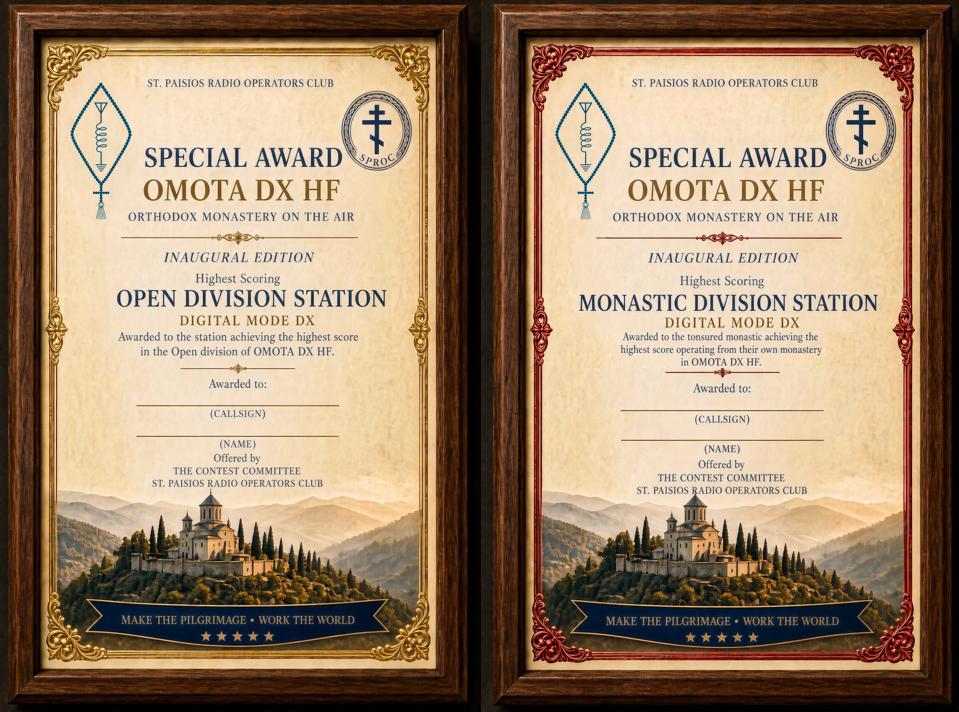
All certificates are electronic and free of charge. Monastic-division entrants compete only against other monastics — if you are a monk or nun with a license (or curious about getting one), the club will gladly help you get on the air.
COURTESY
On blessings and quiet neighbors
A blessing to operate on monastery grounds carries no scoring advantage — the 2-mile zone earns the same points. This is deliberate: no one should ever trouble an abbot or abbess for the sake of a score. Seek a blessing only if you wish to be present at the monastery itself — for the services, the setting, or the fellowship — and accept a "no" graciously and finally.
Wherever you set up, be a quiet neighbor: park legally, keep antennas and cables clear of paths, and let the life of the monastery proceed undisturbed. And if you make the trip — go to church. Vespers and Divine Liturgy are open to visitors at most monasteries. The contest provides the opportunity to visit a monastery you might not otherwise take a detour for. We hope this opportunity for a pilgrimage is spiritually nourishing.
THE CLUB YEAR
Three times a year on the air
OMOTA DX HF is our flagship, and two smaller special events keep the club station active through the year. Each one marks a date in the life of our patron.
Canonization Commemoration
Marks the 2015 glorification of St. Paisios by the Ecumenical Patriarchate. Work the club station, hear a little of what canonization means, and try the optional information challenge if you like.
Feast Day Special Event
On his feast day the club station shares his story on the air: soldier, wireless operator, monk, and counsellor to thousands. An optional information challenge draws on his life and teaching.
OMOTA DX HF
Our international monastery contest, described above. Mobile HF stations from the club operate alongside activators around the world.
Every contact during the January and July events earns a printed QSL card, mailed within 30 days. Cards are free; a voluntary postage donation ($0.68–$1.00 per card) helps cover mailing. Prefer digital? Ask for an ADIF or PDF QSL instead.
Request a QSL cardTHE CLUB
The St. Paisios Radio Operators Club
We are a small amateur radio club in New Hampshire, grown out of an Orthodox parish community. OMOTA DX HF is our flagship event, and the club welcomes every licensed amateur regardless of religious view or denomination to participate in this unique event.
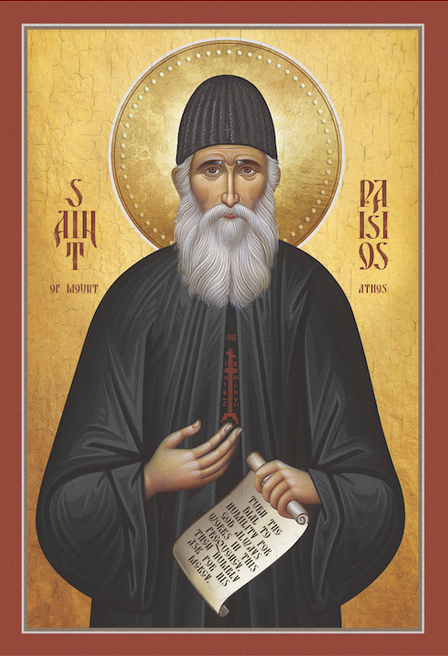
Our patron, St. Paisios the Athonite (1924–1994), was a radio operator before he was a monk. Drafted into the Greek army during the civil war, the young Arsenios Eznepidis served as a wireless operator. When he later took up the monastic life on Mount Athos, his time as a radio operator continued to have a profound impact on the way he experienced his spiritual journey, and how he explained it to others.
Asked why monks withdraw from the world, he answered with an analogy: Monks are the "radio operators" of Mother Church, and therefore, if they depart far from the world, they do it out of love, departing from the distractions of this world in order to be in better contact with God and help people more effectively.
When selecting a namesake for our radio club, we could think of no other Saint that would be more fitting. St. Paisios was glorified by the Ecumenical Patriarchate in 2015; his feast is kept on July 12. Holy Father Paisios, pray to God for us, and help us operate on the 'frequency' of humility, on which God works.
GET INVOLVED
Getting ready
Before the inaugural event we will publish the monastery directory with reference numbers and coordinates, the event date and duration, and the log submission address. To suggest a monastery for the directory, help establish contact with a community, or join the club, write to us.